
Understanding proper court dimensions, scoring mechanics, and service requirements separates recreational play from tournament-level competition. The Badminton World Federation (BWF) maintains a comprehensive framework that governs every aspect of the sport, from the 1.15-meter service height to the rally point system that replaced traditional scoring in 2006. This guide covers all official badminton rules, including doubles court geometry, fault definitions, and match interval protocols that apply in international competition.
How Badminton Works: Key Principles of the Game
Badminton operates as a racket sport where opponents strike a shuttlecock across a net, aiming to land it within the opposing court boundaries while preventing it from touching their own floor. Players compete in either singles format (one versus one) or doubles format (two versus two), with distinct court areas active depending on the match type. The shuttlecock’s unique aerodynamic properties produce a flight pattern unlike any other projectile in sport.
Each rally begins with a service stroke delivered from below 1.15 meters, and points accumulate through the rally point system regardless of which side initiated the serve. The first player or pair reaching 21 points claims the game, provided they lead by at least two points. Matches follow a best-of-three structure, requiring two game victories to secure overall triumph. The shuttlecock may only be hit once per side during each exchange.
Court boundaries shift between service and rally phases in doubles play, expanding the valid target area once the shuttlecock enters active play. The net stands at 1.524 meters at the posts and 1.55 meters at the center. Players rotate service courts after winning points from their own serve. Physical contact with the net or posts during active play constitutes a fault, immediately awarding the point to the opposing side.
BWF in Kuala Lumpur: Global Standards and the Laws of Badminton
The Badminton World Federation operates its headquarters in Kuala Lumpur, Malaysia, where it administers the Laws of Badminton that govern all sanctioned competition worldwide. Established in 1934 as the International Badminton Federation, the organization rebranded to BWF in 2006 and currently oversees 197 member associations across five continental confederations. The BWF Council meets regularly to review and amend regulations.
These laws form Section 4 of the complete BWF Handbook, which also addresses tournament regulations, equipment specifications, and disciplinary procedures. Member nations must implement BWF standards in their national competitions to maintain affiliation status. Continental confederations including Badminton Asia, Badminton Europe, and Badminton Pan Am adopt BWF regulations without modification, ensuring uniform enforcement from local club matches to Olympic finals.
Court and Net Dimensions Established for 1-on-1 Play
Singles badminton utilizes a court measuring 13.4 meters in length and 5.18 meters in width, marked by lines exactly 40 millimeters wide. The net divides the court at its midpoint, suspended by posts positioned on the doubles sidelines even during singles matches. Service courts extend 3.96 meters from the net to the back service line. The center line bisects the court longitudinally, creating left and right service zones of equal dimension.
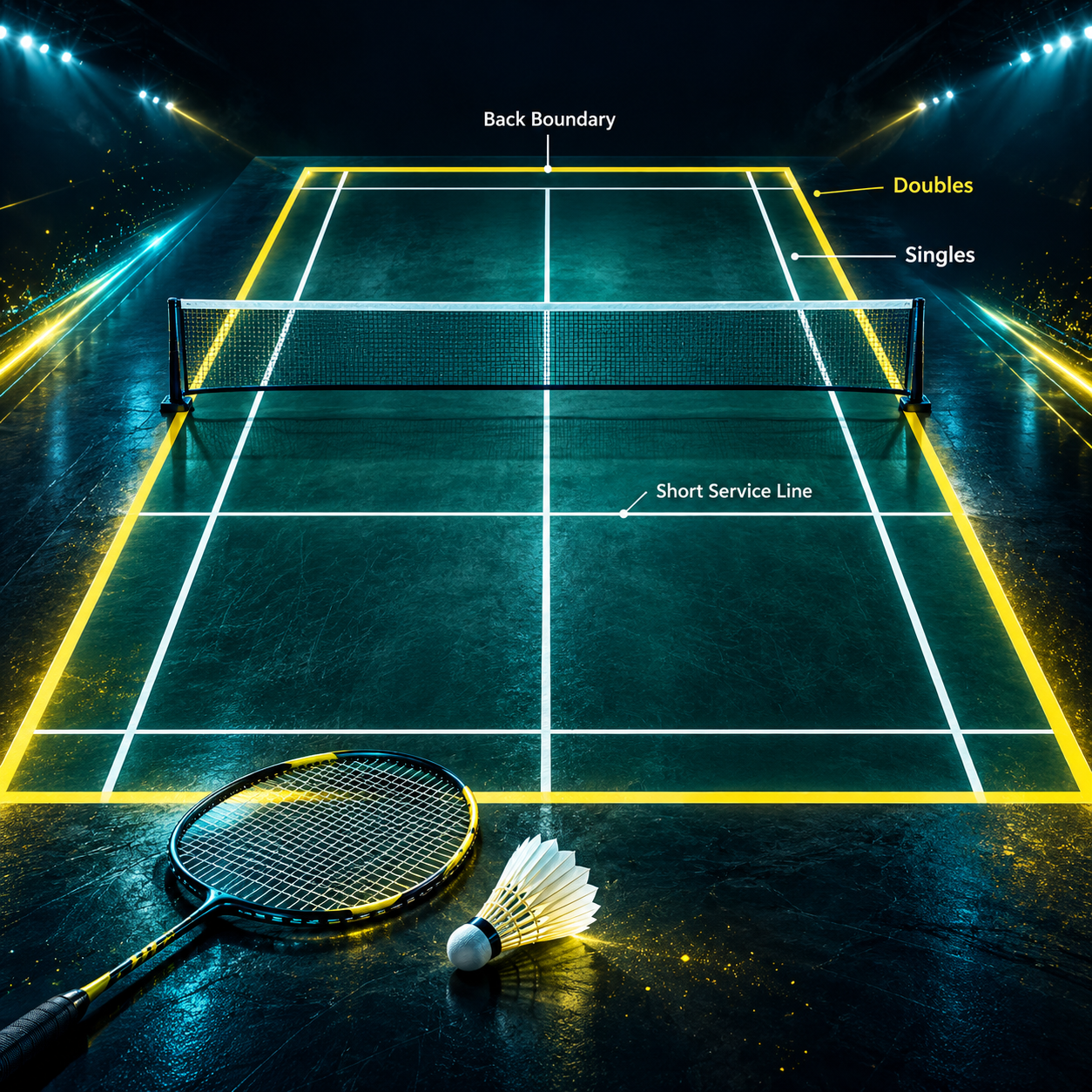
Tramlines — the narrow corridors between singles and doubles sidelines — remain out of bounds during singles rallies, reducing the width to 5.18 meters compared to the 6.1-meter width employed in doubles. However, these outer lanes become valid territory during doubles play, expanding the court area by approximately 18 percent. The short service line sits 1.98 meters from the net, defining the minimum service depth required in both formats. All boundary lines are considered part of the valid playing surface.
Net height specifications call for 1.524 meters at the posts and 1.55 meters at the center, creating a 26-millimeter sag. Posts must be rigid and positioned exactly on the doubles sideline. The net mesh contains openings no larger than 20 millimeters. A white tape 75 millimeters wide covers the net’s upper edge, secured by a cord running through the tape and stretched taut between posts.
How Scoring Works: The Rally Point System and Deuce up to 30
The badminton scoring system awards one point to whichever side wins each rally, regardless of which player or pair served. This rally point method replaced the previous serving-side-only scoring in 2006, accelerating match pace. Games proceed to 21 points, with victory requiring a two-point advantage over the opponent. If the score reaches 20-20, play continues until one side establishes a two-point lead or the score reaches 29-29, at which point the next rally determines the winner at 30-29.
The side winning a rally adds one point to their tally and earns the right to serve in the subsequent rally. When the serving side wins, the server switches service courts but continues serving. When the receiving side wins, they gain both the point and service possession. In doubles, both partners on a team serve consecutively before service transfers to opponents, except at the match start.
Matches employ a best-of-three structure, requiring a side to win two games for overall victory. The deuce-to-30 rule prevents matches from extending beyond 30 points in any single game, ensuring broadcast schedules remain predictable. Players swap court ends after each completed game and again during the third game when the leading score reaches 11 points.
The 1.15-Meter Service Rule: BWF Regulations
BWF regulations mandate that the server’s racket head must remain below 1.15 meters from the court surface at the moment of shuttlecock contact during service delivery. This measurement replaced the previous waist-height rule in 2018, providing an objective standard that officials can verify using fixed-height gauges.

The entire shuttlecock must sit below 1.15 meters at contact.
Service motion requirements specify that both feet must remain stationary from the start of the forward swing until racket contact occurs, with some portion of each foot maintaining contact with the court surface. The server must strike the base of the shuttlecock and deliver the shuttle in an upward trajectory toward the diagonally opposite service court. Any foot movement constitutes a service fault that awards the point to receivers.
The receiving player must stand within the diagonally opposite service court until the server strikes the shuttlecock, after which movement becomes unrestricted. Receivers may not lift their feet before service contact. Umpires positioned in elevated chairs aligned with the net gain optimal sightlines to judge the 1.15-meter height requirement.
Doubles Badminton: Court Markings and Service Geometry
Doubles badminton expands the court width to 6.1 meters by activating tramlines that remain out of bounds during singles play, while simultaneously reducing the service depth by excluding the rear 76-centimeter strip between the back service line and baseline. This creates a service target area measuring 3.96 meters deep and 6.1 meters wide, divided into left and right courts by the center line. Once the shuttlecock enters play after service return, the full court including the back alley becomes valid.
Service rotation in doubles follows a fixed pattern based on score parity. When a side’s score is even (0, 2, 4, etc.), the server delivers from the right service court to the opponent’s right court. Odd scores (1, 3, 5, etc.) shift service to the left court. Partners on the receiving team maintain consistent positional assignments throughout each game. Both feet must remain within the designated service court boundaries until the server contacts the shuttlecock, with violations resulting in fault calls.
Violations and Faults: Net Touching and Overreaching Prohibitions
Contact between any part of a player’s body, clothing, or racket with the net or posts during active play results in an immediate fault, awarding the point to opponents. This prohibition extends from the moment the server initiates forward swing until the rally concludes. Players may not touch the net while following through after a stroke, even if the shuttlecock has already landed. The rule prevents players from intimidating opponents through aggressive net approaches and maintains a physical buffer zone.
Reaching across the net plane to contact the shuttlecock before it crosses to the opponent’s side constitutes an overreach fault, with two exceptions: players may follow through across the plane after making legal contact on their own side, and they may strike a shuttlecock that has already crossed the net if its trajectory will carry it back over without additional contact. A shuttlecock stuck in or resting on the net triggers a let call, requiring the rally to be replayed without point allocation. Players may not catch or carry the shuttlecock on their racket.
Obstructing opponents through deliberate body positioning that prevents them from executing legal strokes results in fault calls. Unsportsmanlike conduct including racket throwing, verbal abuse, or deliberate delays can escalate from warnings to fault penalties to disqualification. The umpire maintains sole authority to call faults for net touches and obstructions.
Match Regulations: Intervals, Change of Ends, and Hawk-Eye Video Replays
Players receive a 60-second interval when the leading score reaches 11 points in any game, during which they may receive coaching, consume beverages, and towel off perspiration. A 120-second interval separates games, allowing equipment changes, full coaching consultations, and physiological recovery. Tournament organizers may extend these intervals to accommodate broadcast requirements.
Court-end changes occur after each completed game and again during the deciding game when the leading score reaches 11 points. This rotation ensures neither player benefits from consistent environmental advantages such as lighting angles or air current patterns. Players have 60 seconds to complete the end change and resume play.
Hawk-Eye technology provides instant video replay capability for line calls, with each side receiving two unsuccessful challenges per game that reset if the leading score reaches 11 points without both challenges being consumed. Players must request reviews immediately after the disputed rally concludes. The system employs 10 high-speed cameras positioned around the court to track shuttlecock trajectory and determine with millimeter precision whether it landed inside or outside boundary lines. Match officials review Hawk-Eye footage on courtside monitors and announce corrected calls within 10 seconds.
FAQ
What are the basic badminton rules for beginners?
Beginners should focus on three core principles: hit the shuttlecock over the net into the opponent’s court, let it land outside boundaries or fail to return it to score points, and reach 21 points with a two-point lead to win each game. Service must be delivered underhand from below 1.15 meters, and the shuttlecock can only be struck once per side before crossing the net.
How does the badminton scoring system work in matches?
The rally point system awards one point to the side winning each rally, regardless of who served. Games proceed to 21 points with a required two-point advantage, extending to a maximum of 30 points if the score reaches 29-29. Matches use best-of-three format, meaning the first side to win two games claims victory.
What are the court dimensions for singles versus doubles badminton?
Singles courts measure 13.4 meters long by 5.18 meters wide, while doubles courts expand width to 6.1 meters by including tramlines. Doubles service courts are shorter, excluding the 76-centimeter back alley that becomes active after service return. The net height remains 1.524 meters at posts and 1.55 meters at center for both formats.
What are the most common faults in badminton rules?
Service faults occur when the racket head exceeds 1.15 meters at shuttlecock contact, when feet move before contact, or when the shuttle lands outside the diagonal service court. During rallies, touching the net or posts, hitting the shuttle twice, or reaching across the net before the shuttle crosses constitutes faults.
How do badminton doubles rules differ from singles?
Doubles expands court width to 6.1 meters and employs shorter service courts that exclude the back alley, which activates during rallies. Both partners serve consecutively before losing service to opponents. Service court selection depends on the serving team’s score being even (right court) or odd (left court).
What is the 1.15-meter service rule in badminton?
The server’s racket head must remain below 1.15 meters from the court surface at the moment of shuttlecock contact. This objective measurement replaced subjective waist-height rules in 2018, allowing officials to verify compliance using fixed-height gauges. Violations result in fault calls that award points to the receiving side.